The Psychology of Revolution by Le Bon Gustave
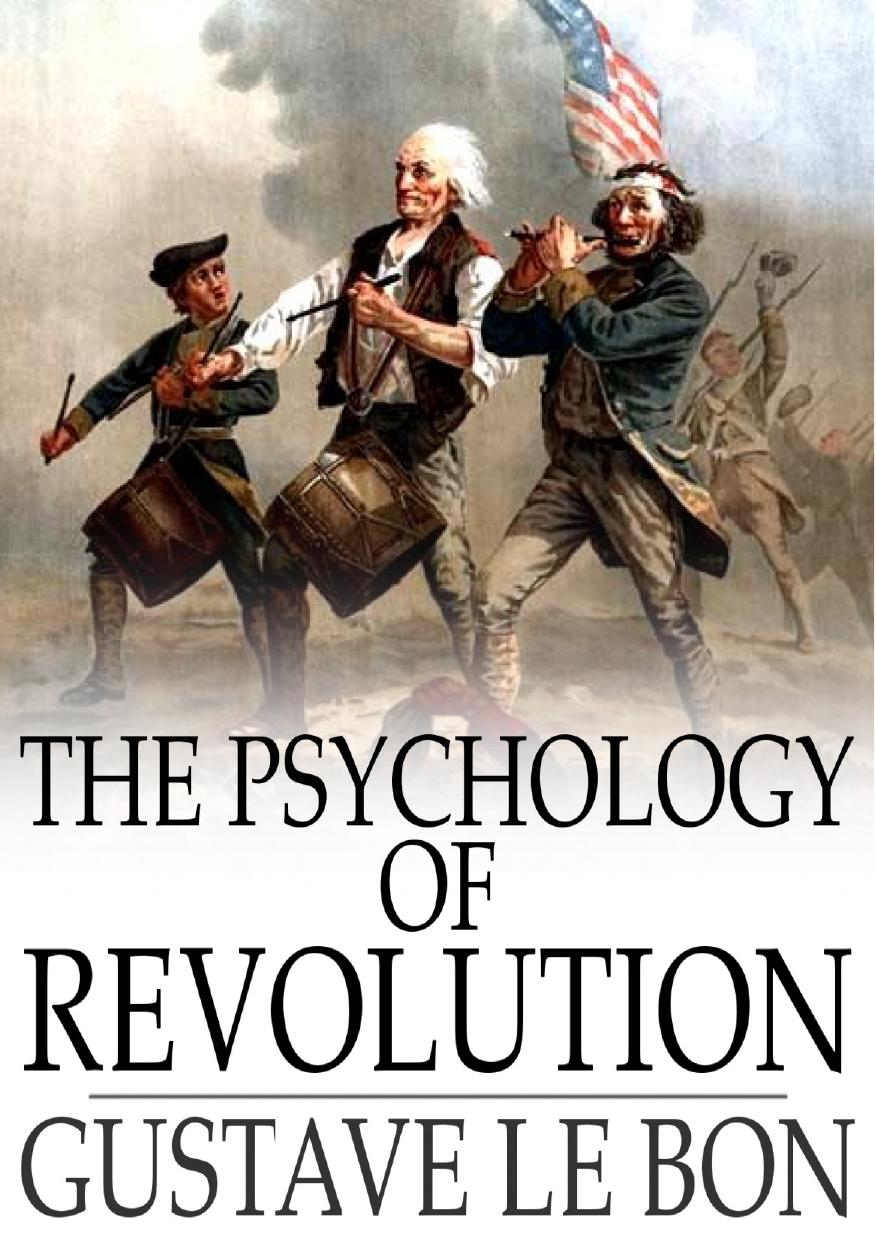
Author:Le Bon, Gustave
Language: eng
Format: azw, pdf
Tags: Social psychology, Revolutions, France -- History -- Revolution, 1789-1799 -- Causes
Published: 2011-03-30T04:00:00+00:00
CHAPTER II
THE PSYCHOLOGY OF THE LEGISLATIVE ASSEMBLY
1. Political Events during the Life of the Legislative Assembly.
Before examining the mental characteristics of the Legislative Assembly let us briefly sum up the considerable political events which marked its short year's life. They naturally played an important part in respect of its psychological manifestations.
Extremely monarchical, the Legislative Assembly had no more idea than its predecessor of destroying the monarchy. The king appeared to it to be slightly suspect, but it still hoped to be able to retain him on the throne.
Unhappily for him, Louis was incessantly begging for intervention from abroad. Shut up in the Tuileries, defended only by his Swiss Guards, the timid sovereign was drifting among contrary influences. He subsidised journals intended to modify public opinion, but the obscure ``penny-a-liners'' who edited them knew nothing of acting on the mind of the crowd. Their only means of persuasion was to menace with the gallows all the partisans of the Revolution, and to predict the invasion of France by an army which would rescue the king.
Royalty no longer counted on anything but the foreign Courts. The nobles were emigrating. Prussia, Austria, and Russia were threatening France with a war of invasion. The Court favoured their lead. To the coalition of the three kings against France the Jacobin Club proposed to oppose a league of peoples. The Girondists were then, with the Jacobins, at the head of the revolutionary movement. They incited the masses to arm themselves—600,000 volunteers were equipped. The Court accepted a Girondist minister. Dominated by him, Louis XVI. was obliged to propose to the Assembly a war against Austria. It was immediately agreed to.
In declaring war the king was not sincere. The queen revealed the French plans of campaign and the secret deliberations of the Council to the Austrians.
The beginnings of the struggle were disastrous. Several columns of troops, attacked by panic, disbanded. Stimulated by the clubs, and persuaded—justly, for that matter—that the king was conspiring with the enemies of France, the population of the faubourgs rose in insurrection. Its leaders, the Jacobins, and above all Danton, sent to the Tuileries on the 20th of June a petition threatening the king with revocation. It then invaded the Tuileries, heaping invectives on the sovereign.
Fatality impelled Louis toward his tragic destiny. While the threats of the Jacobins against royalty had roused many of the departments to indignation, it was learned that a Prussian army had arrived on the frontiers of Lorraine.
The hope of the king and queen respecting the help to be obtained from abroad was highly chimerical. Marie-Antoinette suffered from an absolute illusion as to the psychology of the Austrian and the French peoples. Seeing France terrorised by a few energumens, she supposed that it would be equally easy to terrify the Parisians, and by means of threats to lead them back under the king's authority. Inspired by her, Fersen undertook to publish the manifesto of the Duke of Brunswick, threatening Paris with ``total subversion if the royal family were molested.''
The effect produced was diametrically opposite to that intended.
Download
The Psychology of Revolution by Le Bon Gustave.pdf
This site does not store any files on its server. We only index and link to content provided by other sites. Please contact the content providers to delete copyright contents if any and email us, we'll remove relevant links or contents immediately.
Rewire Your Anxious Brain by Catherine M. Pittman(18711)
Talking to Strangers by Malcolm Gladwell(13440)
The Art of Thinking Clearly by Rolf Dobelli(10598)
Mindhunter: Inside the FBI's Elite Serial Crime Unit by John E. Douglas & Mark Olshaker(9420)
Becoming Supernatural by Dr. Joe Dispenza(8277)
Change Your Questions, Change Your Life by Marilee Adams(7847)
Nudge - Improving Decisions about Health, Wealth, and Happiness by Thaler Sunstein(7758)
The Road Less Traveled by M. Scott Peck(7662)
The Lost Art of Listening by Michael P. Nichols(7548)
Mastermind: How to Think Like Sherlock Holmes by Maria Konnikova(7432)
Enlightenment Now: The Case for Reason, Science, Humanism, and Progress by Steven Pinker(7354)
Win Bigly by Scott Adams(7263)
The Way of Zen by Alan W. Watts(6672)
Daring Greatly by Brene Brown(6557)
Big Magic: Creative Living Beyond Fear by Elizabeth Gilbert(5833)
Grit by Angela Duckworth(5673)
Ego Is the Enemy by Ryan Holiday(5527)
The Laws of Human Nature by Robert Greene(5325)
Men In Love by Nancy Friday(5292)
